What a Bicycle Headset Actually Connects
Learn what a bicycle headset connects, how it differs from the stem, and what to check before choosing a replacement that fits the frame and fork.
What does a bicycle headset connect, and how is it different from the stem? A bicycle headset supports the fork’s steering rotation where the fork’s steerer passes through the frame. The stem holds the handlebar and attaches it to the steerer. Knowing which part does what helps you read bicycle specifications and identify what information you need when replacing a component.
The headset supports the fork as it turns in the frame
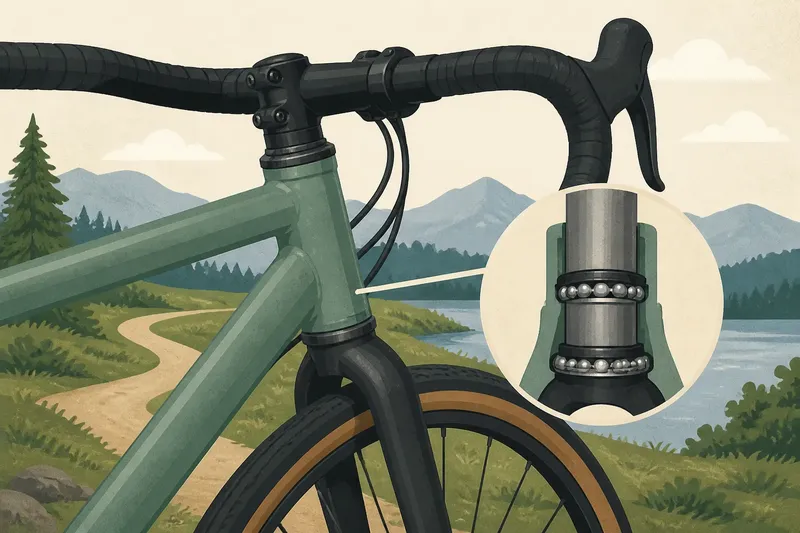
At the front of a bicycle, the fork’s two blades hold the front wheel. They meet at the fork crown and continue upwards as one tube, called the steerer. The steerer passes through the frame’s head tube, the short tube at the front of the frame.
The headset is the assembly fitted around the steerer and head tube. It supports the steerer at the top and bottom of the head tube while allowing it to rotate. The fork can then turn the front wheel left or right without the frame turning with it.
A headset is not a hinge with a separate arm. Its bearings support the steerer while letting it rotate inside the head tube. The headset also helps carry forces between the front wheel and the frame.
When you turn the handlebar, the stem moves the steerer and fork. The headset supports that movement at the frame; it does not supply the steering input itself.
The headset, stem and bearings have different jobs
These parts meet in the same area, but each has a distinct role.
- Headset: the assembly that supports steering rotation where the steerer passes through the frame. Its parts can include bearings, cups or bearing seats, seals and adjustment pieces.
- Bearings: the rolling parts and surfaces that let the steerer turn while supporting load. Some designs use sealed cartridge units; others use loose balls held in a retainer or race arrangement.
- Stem: the component that clamps the handlebar and connects it to the steerer. It positions the handlebar; it is not the headset’s bearing system.
- Steerer: the upper tube of the fork that passes through the head tube and connects to the stem.
- Head tube: the frame tube through which the steerer passes and where the headset is fitted.
Follow the movement from hand to wheel: your hands turn the handlebar, the stem transfers that movement to the steerer, and the fork turns with it. The headset supports the steerer’s rotation at the frame.
The headset does not set handlebar height or reach by itself. Those depend on the frame and fork dimensions, stem position and, where fitted, spacers. The stem—not the headset—clamps the handlebar.
Headset designs describe how parts fit together
The headset’s basic job stays the same across bicycle designs, but the way it fits the frame and fork varies. Similar-looking headsets are not necessarily interchangeable.
A threaded headset is commonly paired with a threaded steerer. A quill stem fits inside the steerer and is secured there. Threaded parts on the steerer are used to adjust the headset. This arrangement appears on some traditional and utility bicycles.
A threadless headset is paired with a smooth, unthreaded steerer. The stem clamps around the outside of the steerer, and a compression arrangement is used to adjust the headset. “Threadless” describes the steerer and stem arrangement, not the absence of bearings or adjustment.
Other terms describe how the bearings sit in the frame. In a cup-and-cone design, the bearings run against separate surfaces called races, often held in cups. A cartridge headset uses sealed bearing units: each unit fits into a shaped seat in the headset or frame. With an integrated design, the frame’s head tube has the shaped seats for the cartridge units, so separate pressed-in cups are not used. These terms describe construction, not a different steering function.
If you need a replacement, identify the frame’s head tube arrangement and the fork’s steerer type. A broad label such as “road headset” does not establish compatibility. Check the frame or bicycle manufacturer’s specifications, or ask a bicycle shop to identify the standard.
Check these details before choosing a headset
Use the information available to decide what to do next. If a specification is missing or unclear, do not choose a replacement from a broad category name alone.
- Frame specification: Check the frame maker’s headset standard. If it identifies the standard, use that information to narrow the replacement; if it is missing, ask the maker or a bicycle shop to identify it.
- Head tube arrangement: Check whether the frame uses separate cups or shaped seats for the bearings. If the arrangement is specified, match it; if you cannot confirm it, do not assume a headset with a similar appearance will fit.
- Fork steerer: Check whether the steerer is threaded or smooth and unthreaded. If it is threaded, look for a compatible threaded arrangement; if it is unthreaded, check for a threadless design.
- Stem arrangement: Check whether the stem fits inside the steerer as a quill or clamps around its outside. If the stem and steerer arrangement is clear, use it to rule out incompatible designs; if not, ask a shop to inspect the parts.
- Existing headset markings: Check for a maker’s name or model marking. If it identifies the headset, compare that information with the frame and fork specifications; if it does not, treat it as a clue rather than proof of fit.
- Complete bicycle listing: Check whether the description names only a general type or gives a frame standard. If it gives a standard, verify it against the frame and fork; if it gives only a broad label, request the detailed specification before buying replacement parts.
Say you are considering a bicycle whose listing calls the headset “threadless cartridge”, but gives no frame standard. You check the maker’s frame specification and find that it names a particular headset arrangement; you then compare that with the fork’s unthreaded steerer and the stem that clamps around it. If the details agree, you can look for a replacement matching that standard; if the frame specification is unavailable or conflicts with the listing, you would ask the maker or a bicycle shop before ordering. The hypothetical details identify the decision process, not a real bicycle or a universal fit rule.
How do the headset and steering parts work together?
Does the headset turn the front wheel by itself?
No. The rider turns the handlebar, and the stem transfers that movement to the steerer and fork. The headset supports the fork’s rotation where the steerer passes through the frame.
Are headset bearings the same as a headset?
No. Bearings are parts of many headsets, while “headset” names the wider assembly. Depending on the design, that assembly can also include cups, bearing seats, seals and adjustment parts.
Is the stem part of the headset?
No. The stem works with the headset and steerer, but it is a separate component. It holds the handlebar and attaches it to the steerer; the headset supports the steerer’s rotation through the frame.
Can one headset fit any frame or fork?
No. Fit depends on the frame’s head tube and the fork’s steerer, as well as the headset design. Check the manufacturer’s specification or ask a bicycle shop to identify the correct standard before choosing a replacement.
Read a headset specification by separating function from fit
The most useful starting point is function: the headset supports the steerer’s rotation where it passes through the frame. The bearings allow that movement, while the stem carries handlebar movement to the steerer.
A headset specification describes the steering assembly and how it fits the frame and fork. A stem specification describes the handlebar connection and position. If you are shopping for a bicycle headset, use the frame and fork details to confirm compatibility rather than relying on a familiar label alone.
Keep one simple picture in mind: the steerer rotates inside the head tube, supported by the headset. The handlebar and stem turn it, the fork follows, and the headset provides the supported connection at the frame.