The Safety Bicycle and the Shape We Still Recognise
Learn how the safety bicycle’s familiar proportions addressed limits of the high-wheeler and why its rider, frame, wheels and chain still shape bicycles.
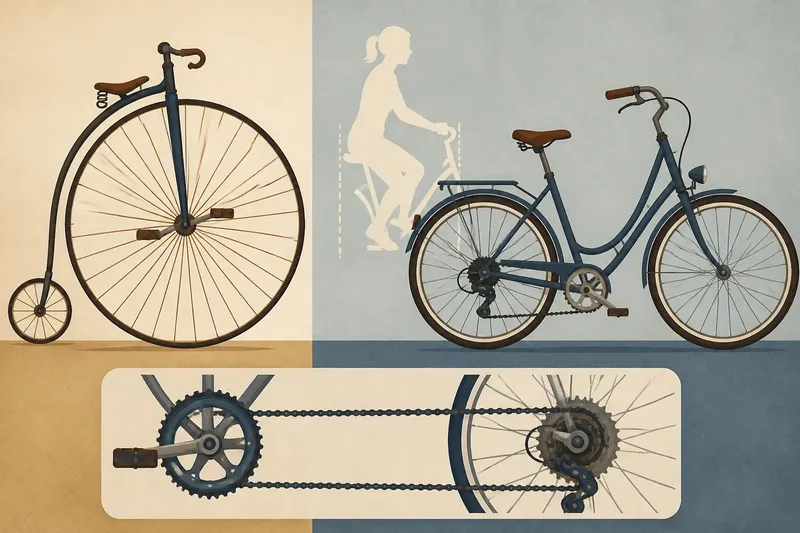
Why does the safety bicycle look so much like the bicycle parked outside your door? The safety bicycle’s familiar shape emerged as designers brought two wheels of broadly similar size, a chain drive and a frame that placed the rider between the wheels into one arrangement. Its proportions addressed problems posed by the high-wheeler, though how easily a rider reaches the ground still depends on fit and the individual bicycle.
The high-wheeler put its rider above the driving wheel
Imagine a rider trying an early high-wheeler, with a large front wheel and a small wheel behind. The large wheel connected the pedals directly to the road, but it also raised the rider high above the ground. A sudden stop or an uneven patch could make the machine difficult to control, and mounting it called for a practised movement.
The safety bicycle changed the design problem: how could a bicycle place its rider between two wheels while still transferring pedal force to the road? Its answer was a chain drive to the rear wheel and wheels of broadly similar size. The rider sat between them rather than above an oversized front wheel.
“Safety” describes a design direction, not a promise that a bicycle cannot fall or cause injury. The lower overall arrangement avoided the high-wheeler’s elevated riding position, but it does not by itself tell you whether a particular rider can put a foot down. Rider height, frame size, saddle position and the shape of the bicycle all matter.
The safety bicycle’s proportions connect rider, frame and wheels
Look at a familiar bicycle from the side. The wheels meet the ground at two points, and the frame holds them apart. The saddle places the rider between them, while the handlebars reach forward to the wheel that steers. These relationships reveal more than any single tube angle or frame shape.
On a conventional safety bicycle, the front wheel steers and the rear wheel receives power through the chain. Turn the handlebars to guide the front wheel; press the pedals to drive the rear. The chain lets the pedals sit away from the front wheel, so the front wheel need not be enormous to transmit the rider’s effort.
The familiar diamond frame became a durable way to connect the steering area, seat area and rear wheel. Its tubes form triangles, which help the frame resist changes in shape under ordinary riding forces. Other frame designs arrange these connections differently, but the bicycle still needs room for the rider to pedal, steer and balance.
Trace the main lines with your eyes: from the steering head towards the crank, from the crank towards the rear axle, and from the saddle area back towards the rear wheel. These connections show how the frame supports the rider and links the wheels. They also explain why a bicycle can look familiar while its proportions suit a different purpose.
The chain carries pedal force to the rear wheel
The chain drive helped make the lower riding position useful. On a direct-drive high-wheeler, the pedals were attached to the driving wheel’s axle. With a chain and sprockets, designers could place the pedals lower and carry their turning motion to the rear wheel.
A sprocket is a toothed wheel that engages with the chain. The front sprocket turns with the cranks; the rear sprocket turns the back wheel through its hub. This arrangement leaves the front wheel free to steer and allows the rider’s legs to turn the pedals without sitting above a towering wheel.
Say you are comparing a drawing of a high-wheeler with one of a modern city bicycle. Trace one pedal turn in each. In the high-wheeler, the pedal axle is at the centre of the driving wheel; in the city bicycle, the chain carries the turning motion rearwards. The drawings show two different ways to connect pedalling to forward movement, and why the chain-driven layout can place its rider lower.
Frame geometry changes posture without fixing foot reach
“Geometry” means the dimensions and angles that determine where the wheels, saddle, pedals and handlebars sit in relation to one another. Changes to those relationships can affect how upright a rider sits, how far they reach and how the bicycle responds to steering. They do not determine foot reach on their own: fit and the rider’s body matter too.
A town bicycle may place its handlebars higher or closer to the saddle than a road bicycle does, encouraging a more upright posture. A road bicycle commonly has lower, farther-forward handlebars and a more extended riding position. A touring bicycle may make room for luggage while allowing a position suited to longer outings. These are tendencies, not rules for every model.
When comparing bicycles, look at the saddle’s position relative to the handlebars, the distance between them and the space available for practical equipment. For foot reach, consider the actual bicycle and rider rather than relying on the outline alone. A bicycle’s frame design can change how the rider mounts or sits, but it cannot tell you by itself whether a rider can comfortably reach the ground.
Questions readers ask about the safety bicycle’s form?
What makes a bicycle a safety bicycle?
The term usually refers to the two-wheel arrangement with a chain drive and a lower riding position that displaced the high-wheeler as the standard bicycle form. Its defining idea is the relationship between rider, frame and wheels, not one exact tube shape.
Why are the wheels usually close in size?
Wheels of broadly similar size allow the rider to sit between them rather than above an oversized driving wheel. Wheel sizes still vary by bicycle type, while the front-steering, rear-driven arrangement remains recognisable.
Does every modern bicycle use a diamond frame?
No. Step-through frames, folding bicycles and other designs change or remove parts of the classic diamond shape to suit different uses. They can still follow the safety bicycle’s central arrangement, with steering at the front and drive at the rear.
Why did the shape survive so many changes?
It separates steering from propulsion and places the rider between the wheels. Designers can change materials, equipment and proportions while keeping those basic relationships.
Read a bicycle by following its steering and drive
Imagine you are looking at an invented, hypothetical drawing of a step-through bicycle beside a high-wheeler. Start with the step-through drawing: note that the rider sits between two wheels, the front wheel is attached to the steering assembly, and a chain runs from the pedals to the rear wheel. Then trace the high-wheeler: its pedals sit at the centre of its large front wheel, which both steers and receives the drive. The resulting comparison shows that frame shape can change while the basic safety-bicycle arrangement remains distinct.
The safety bicycle’s form endured because it brought rider position, steering and propulsion into a coherent layout. To read the safety bicycle in a bicycle you see today, identify where the rider sits, which wheel steers and how pedal force reaches the driven wheel. Those details explain more than resemblance alone, while leaving room for each frame to fit its rider differently.