Flat Pedals or Clipless: What Changes at the Foot
Flat pedals or clipless pedals change how shoes meet the bike. Compare shoe choice, foot placement and getting on or off to choose a suitable system.
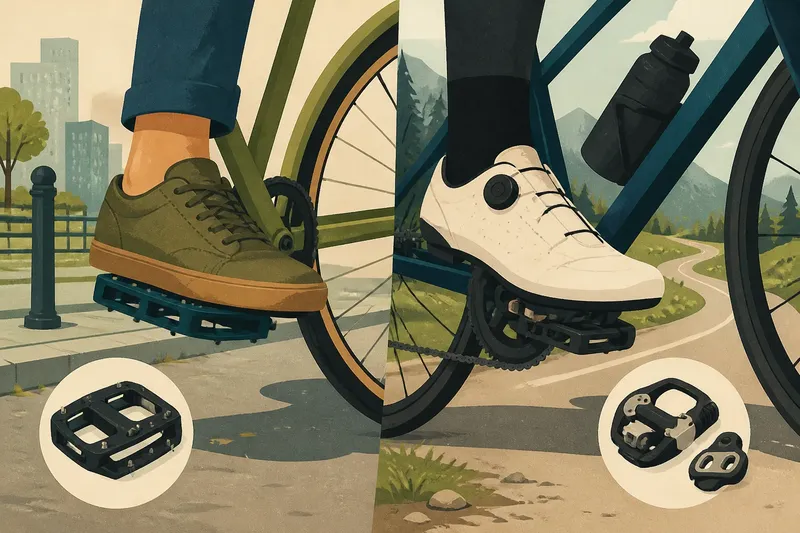
Flat pedals or clipless pedals change what your feet need to do before, during and after a ride. The main difference is the connection: a flat pedal supports the sole without attaching it, while a clipless pedal holds a cleat fitted to a compatible shoe.
What is the difference between flat and clipless pedals?
A flat pedal has a broad platform, often with small pins or a textured surface to help a shoe stay in place. You step onto it and can lift your foot away whenever you choose. The pedal does not require a special shoe.
A clipless system connects the pedal to a cleat on the shoe. The cleat engages with the pedal when you press down in the right position; a twisting movement releases it. The name can sound backwards: “clipless” distinguishes these pedals from older toe clips and straps, not from the cleat connection they use.
Some flat pedals are simple and smooth, while others have shaped platforms and replaceable pins. Clipless systems also vary. Road pedals commonly use larger cleats that project from the sole, whereas many mountain-bike systems use smaller recessed cleats. These are broad tendencies, not rules, so check which pedal and cleat standards are compatible before buying.
Do clipless pedals make you pedal more efficiently?
They change how the foot is held, but they do not automatically make a rider faster or more efficient. A cleat can keep the foot in a consistent position on the pedal and makes it harder for the shoe to slip off during rough riding. That can feel reassuring, particularly when a rider wants the same foot placement each time.
It is common to hear that clipless pedals let you pull upwards on every stroke and thereby create more power. A rider can pull against the connection, but doing so does not mean that every part of the pedal stroke becomes more useful. The practical value depends on the rider, the terrain, the shoe fit and the reason for choosing the system.
Flat pedals allow the foot to move freely, which can make it easier to adjust its position as the ride changes. This freedom can also suit learning and low-speed manoeuvres, where a rider may want to put a foot down quickly. Neither system removes the need for comfortable positioning or smooth pedalling.
Can you use ordinary shoes on flat pedals?
Usually, yes. Flat pedals work with everyday footwear, though the sole makes a difference. A flexible or very smooth sole may feel less stable on a small platform than a firmer, grippier one. A broad, supportive shoe with a tread that sits well on the pedal can feel more settled.
Some riders use skate-style shoes or cycling-specific flat-pedal shoes. These often have flatter, grippy rubber and a sole that supports the foot without being as stiff as many road-cycling shoes. That can be a useful compromise for riding to work, stopping often or walking at the destination.
Ordinary shoes can also be a sensible choice when the bicycle is shared or used for varied errands. The trade-off is that a shoe designed mainly for walking may not feel as secure or supportive on the pedal as one chosen for cycling. Avoid footwear that can catch on the crank or pedal, and choose a shoe that stays comfortable when you are both riding and walking.
What shoes do clipless pedals need?
Clipless pedals need cycling shoes with a sole and cleat fittings that match the pedal system. The cleat is the small metal or plastic fitting attached to the shoe; it is what engages with the pedal. A shoe can look suitable but still be incompatible if its fittings do not match the cleat standard.
Road shoes often have a relatively smooth, stiff sole. Their cleats can extend beyond the sole, which may make walking awkward or noisy on hard floors. Mountain-bike shoes commonly recess the cleat into a treaded sole, making them easier to walk in and less exposed when a rider steps on rough ground.
There are also touring and commuter shoes intended to balance pedalling support with walking comfort. Their appearance does not settle compatibility: check the shoe’s fitting pattern and the pedal maker’s specified cleat. The pedal and shoe instructions determine which parts fit together and how the cleat should be positioned.
Which system is easier to get on and off?
Flat pedals are simpler at stops: lift your foot clear, then place it back on the platform when you set off. You do not need to engage or release a cleat, and you can choose where on the pedal to put your foot. This can suit crowded routes, frequent traffic lights and casual riding.
Clipless pedals require a deliberate release before the foot can come away. Riders typically learn to rotate the heel outwards, though the exact movement and feel depend on the pedal. Starting also requires the cleat to engage. Some systems allow the rider to clip in on one side of the pedal; others have a different entry arrangement, so practise the motion somewhere quiet before relying on it in traffic.
Say you are choosing pedals for a short route with repeated shop stops. If you select flats and a comfortable everyday shoe, you can step off without changing footwear or thinking about release. If you choose clipless instead, a compatible shoe and a practised twist become part of each stop and start; the expected difference is a more fixed connection while riding, with an extra action at the kerb.
Can you walk comfortably in clipless shoes?
That depends more on the shoe and cleat design than on the word “clipless”. A road shoe with a projecting cleat can be clumsy on pavement. A mountain-bike or touring shoe with a recessed cleat and a walking tread is usually easier to manage away from the bicycle.
Even a recessed cleat may feel different underfoot from an ordinary shoe, and the sole may be stiffer. If your ride includes a café, a station or a long walk to a destination, consider how the shoes feel on those surfaces as well as on the pedals. For a ride that ends at the front door, walking performance may matter very little.
Which pedal system suits commuting, leisure riding or trails?
For a commute with frequent stops and a need to wear normal clothes, flats are often the more convenient option. They let you use ordinary shoes and make quick dismounts straightforward. A flat-pedal cycling shoe can add grip and support without requiring a cleat system.
For a long road ride where the rider values a consistent foot position and already has compatible shoes, clipless pedals may be appealing. Road shoes can feel firm underfoot while pedalling, but their projecting cleats may be inconvenient for walking. A touring shoe and compatible pedal can provide a different balance if walking is part of the day.
On trails, either system can work. Flats make it easy to dab a foot when a turn or obstacle feels uncertain, and a grippy shoe can help keep the foot settled. Clipless pedals keep the shoe attached over rough ground, but require a release movement when the rider wants to put a foot down. Personal confidence and the conditions of the ride matter more than a universal rule.
How should you choose between flat pedals and clipless pedals?
Start with the times your feet leave the pedals, not with a claim that one system is always superior. Consider whether you need to walk in your riding shoes, how often you stop, whether you already own compatible shoes and how comfortable you feel practising a release motion.
- Choose flats if ordinary shoes, quick dismounts or easy foot repositioning matter most.
- Consider clipless if you want a fixed connection and are content to use compatible shoes and cleats.
- Look at recessed cleats if you want clipless pedals but expect to walk during the ride.
- Check the complete system before buying: pedal, cleat and shoe fittings must match.
- Try the release motion in a quiet place if you are new to clipless pedals, and choose a setup you can operate calmly.
Flat pedals or clipless pedals are ultimately a choice about how much connection you want at the foot and what you are willing to carry or practise in return. For many riders, the sensible starting point is the system that fits their shoes, stops and routes; changing later is possible if those needs change.