A Bigger Gear Is Not Automatically a Faster Gear
A bigger bicycle gear means more distance per pedal turn, but not always more speed. Learn how terrain, cadence and smooth shifting guide your choice.
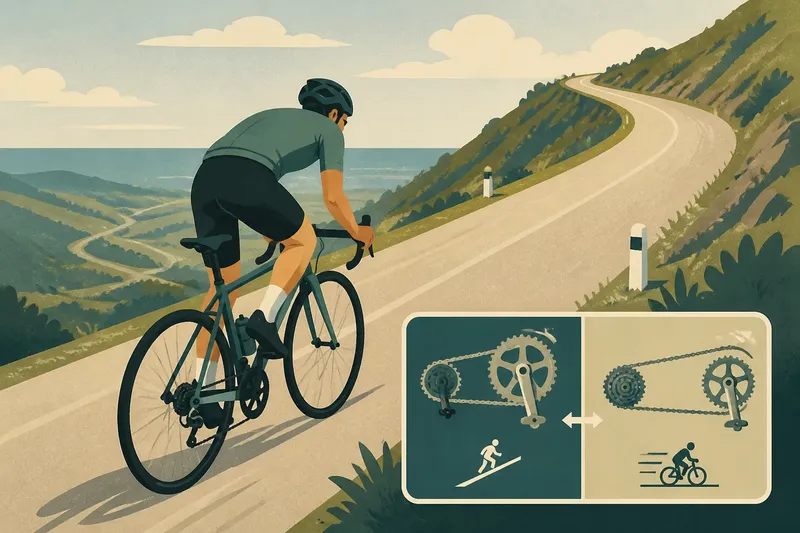
Why can a bigger bicycle gear feel slower on a hill? It turns the wheel farther with each crank rotation, but asks you to push harder. If that load makes your pedal stroke falter, a lower gear may help you keep moving smoothly. The useful choice depends on the terrain, your cadence and the effort you can sustain.
Gear ratios trade easier pedalling for distance per turn
On a derailleur bicycle, the chainring at the front and sprocket at the rear work together to set the gear. A large chainring paired with a small rear sprocket gives a high gear: each full crank turn drives more rear-wheel rotation. A small chainring paired with a large sprocket gives a low gear, moving the wheel less per turn while making the pedals easier to push.
This is a mechanical trade-off, not a promise of speed. In a high gear, you cover more ground per pedal turn only if you can keep turning the cranks at a useful rate. On level ground, with manageable resistance, the gear may feel smooth. Against a hill or headwind, the same gear may demand more force than you can comfortably apply.
Compare gears within the range of your bicycle. The number of chainrings and sprockets alone does not tell you how hard a gear feels; their sizes and the wheel also matter. You do not need to calculate ratios to choose while riding. Notice whether the pedals respond smoothly under your feet.
Cadence helps you judge whether a gear suits the moment
Cadence is how quickly you turn the pedals. In a very high gear, your cadence may slow and each downstroke feel heavy. In a very low gear, your legs may spin quickly while the bicycle gains little ground. A comfortable working rhythm varies with the rider, bicycle and situation.
Use the feel of the pedal stroke as a guide rather than aiming for one universal cadence. If you rock your body, strain to push through each turn or struggle to pedal smoothly, try an easier gear. If your legs spin without steady pressure, shift up one gear at a time and check whether the rhythm remains controlled.
A bicycle computer can display cadence, but you do not need one. Listen for a regular pedal stroke and notice whether your breathing and posture remain settled. The aim is to avoid turning a manageable effort into a grind or a frantic spin.
Terrain changes how a useful gear feels
On a climb, gravity and rolling resistance ask for more effort. Shifting down before the slope becomes steep can help you keep the cranks moving without a sudden, heavy push. On a descent, a low gear may leave the pedals spinning too quickly to add useful drive. A higher gear may suit the faster roll if you can still turn it smoothly.
Rolling roads call for small adjustments. You may keep your gear over a short rise, while a longer incline may make an easier one more comfortable. A headwind also increases the effort of moving forward, even on level ground. Respond to the resistance you feel, not just to the shape of the road.
Say you are approaching a gradual hill in a high gear and the pedals begin to feel heavy. Shift down before your cadence collapses; the next turns should be easier to keep smooth. When the road levels, shift back up if the lighter gear makes your legs spin too freely. This invented situation illustrates how a gear change responds to a changing load.
Shift smoothly and allow for different drivetrains
On many derailleur bicycles, briefly easing pedal pressure as you shift can help the chain move between sprockets. The right technique depends on the drivetrain, gear combination and conditions. Avoid forcing a shift while pushing hard, especially on a steep section. If a climb is approaching, select an easier gear while you still have enough momentum and control to make the change calmly.
When unsure, shift one step at a time. A small change makes it easier to judge whether the pedal stroke improves. If it still feels too heavy, shift lower again; if the cranks become uncomfortably quick, move back up. Internal-gear hubs and electronic systems can behave differently, so follow the bicycle or component maker’s operating guidance.
Common questions about bicycle gears?
Does a larger chainring always make a bicycle faster?
No. It increases the distance travelled per crank turn in that gear, but you still have to turn the pedals against the load. If the gear is too hard to sustain, a lower gear may be more useful.
Should I use a low gear on every hill?
Not necessarily. Choose a gear that lets you pedal steadily at a manageable effort; a short rise may not call for a shift, while a longer or steeper climb often does. Anticipate the change rather than waiting until you can barely turn the cranks.
Is spinning faster always more efficient?
No. A quick cadence can feel light, but an excessively fast spin may be difficult to control and may not suit your riding. Aim for a smooth, comfortable rhythm rather than a universal cadence target.
Why does the same gear feel different on different rides?
Wind, gradient, surface, fatigue and pace all affect the resistance you meet. A gear that feels easy on a sheltered, level road can feel demanding into a headwind or on a rough incline.
Choose a gear that keeps effort manageable
When choosing between adjacent gears, listen for a smooth pedal stroke and notice whether you can maintain your posture without bracing your shoulders or rocking your hips. Those signs matter more than the size of the chainring. A high gear suits conditions that let you turn it steadily; a lower one can help when the alternative is grinding.
On a ride with changing terrain, expect to shift as the load changes rather than searching for one ideal gear. If a gear repeatedly feels too heavy or too light on your usual routes, the bicycle’s gearing range may not suit those conditions. A bike shop can explain the options for your bicycle. A bigger bicycle gear means more distance per turn, but that advantage matters only while you can keep turning it smoothly.